
Making changes to your Dado experience before launch
If you’ve opted for our Employee Experience Design & Implementation Service, the first draft of your Experience will be built by our Product Specialists.
However, you’re the expert on your own processes, so you’ll surely want to make some tweaks to the Experience before launching. This article guides you through the most common changes you’ll want to make at this stage.
If you get stuck or want to make more comprehensive changes, reach out to your Customer Success Manager and they will guide you through it.
- General guidelines to editing your experience
- Changing the text in a Task or Message
- Changing the images in a Task or Message
- Adding a new block to a Task or Message
- Changing the options in a Select Option subtask
- Changing links, in Visit Link subtasks and in text blocks
- Changing the notification channels for a Task or Message
- Changing the reminder settings for a Task
- Changing the deadline for a Task
- Changing the start/send date for a Task or Message
- Changing which parts of a Task or Message are assigned to a Target Audience
General guidelines to editing your experience
View mode and edit mode
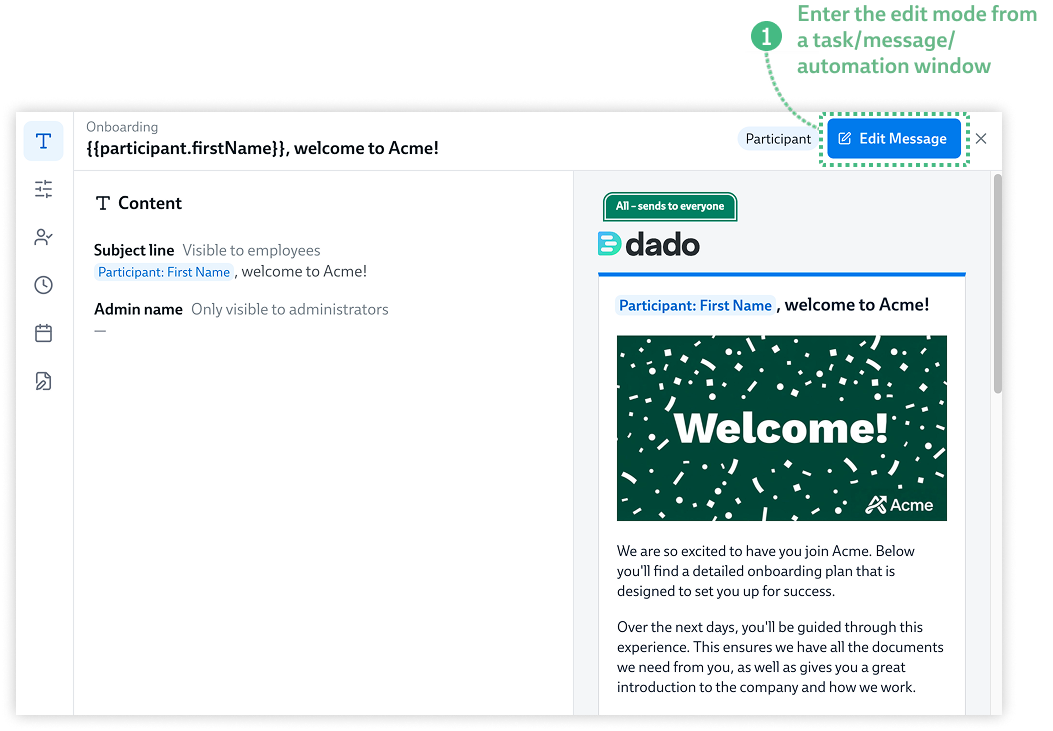
Your Experience has a ‘view mode’ and an ‘edit mode’. You will need to enter edit mode to make changes. You can do this two ways.
Either click the Edit button on the top right of the page in view mode, then select Timeline in the left hand navigation.

Or click any Timeline item, then click the Edit button in the top right of that window.
One person editing at a time
Dado works best when only 1 person is actively editing an Experience at once. If two people are editing at the same time, you risk accidentally overwriting each other’s changes.
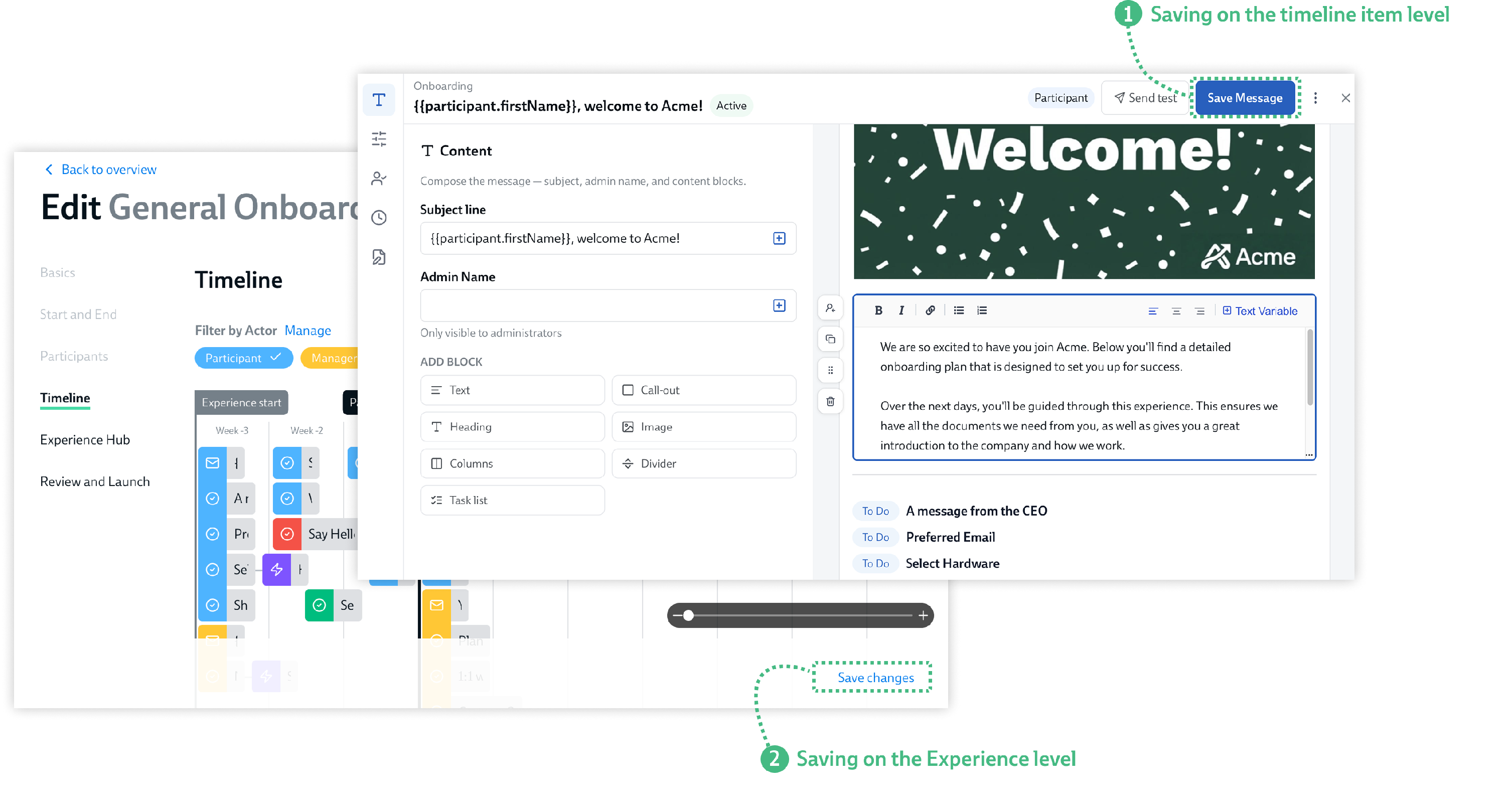
Save regularly, at all levels
When you are the person editing the Experience, we recommend you save your work regularly. You should save the changes you make to each Task, Message or Automation, using the save button in the top right of its window (for example Save Task or Save Message); and then save the changes to the Experience. Be sure to save at all levels.
Changing the text in a Task or Message
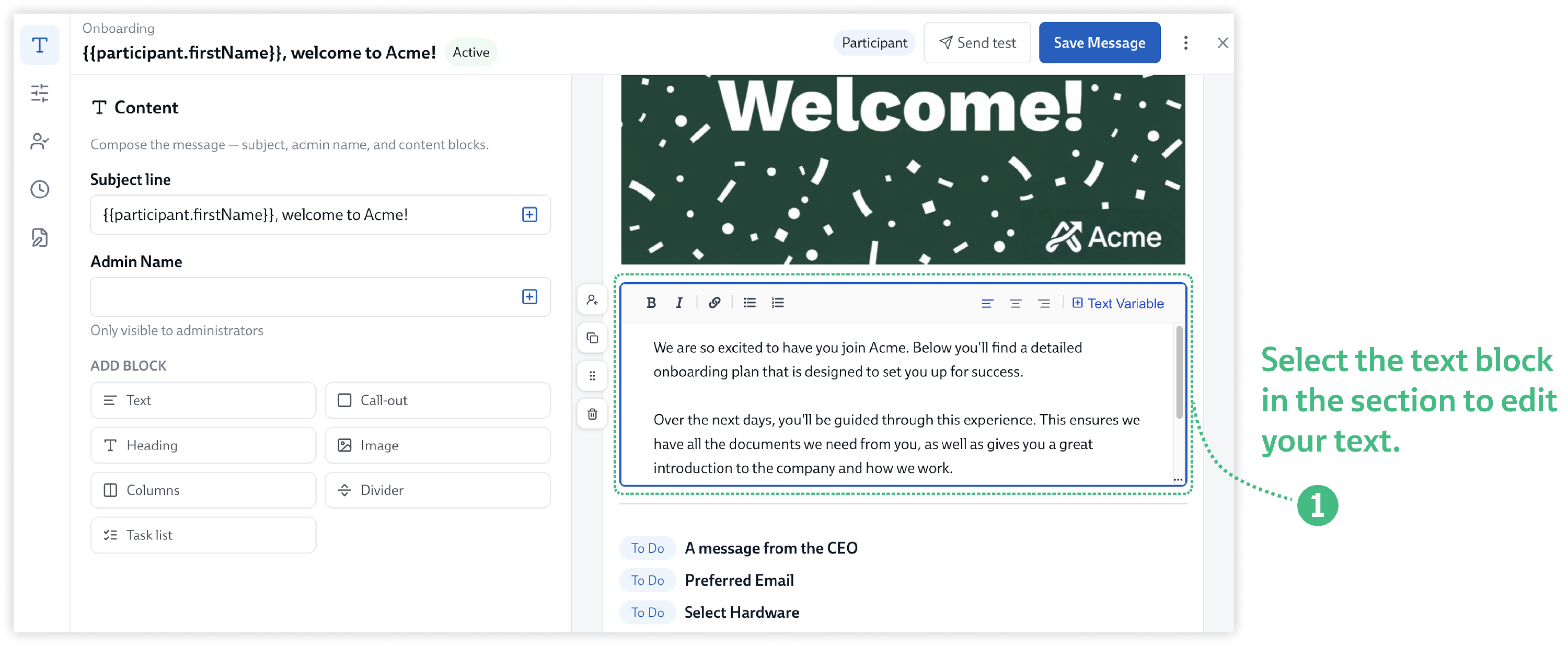
Open the Message or Task you’d like to change, in edit mode. Click the text you’d like to edit in the preview. It becomes editable in place, with a toolbar for formatting your text.
Don’t forget you can add variables to personalize this content using the Text Variable button, and don’t forget to save when you’ve made your changes!
Changing the images in a Task or Message
Open the Message or Task you’d like to change, in edit mode. Click the image you’d like to edit in the preview. Its content block settings open in the left sidebar. This is where you can replace the image (using Enter URL or Upload Image), and change its Size or alignment.
Don’t forget to save when you’ve made your changes!

Adding a new block to a Task or Message
Tasks and Messages are built up of blocks of two kinds:
- Content blocks, like text, headings or images
- These can be used in both Tasks and Messages
- Subtasks, like Visit Link, Confirm Action, Upload File and more
-
These can only be used in Tasks
-
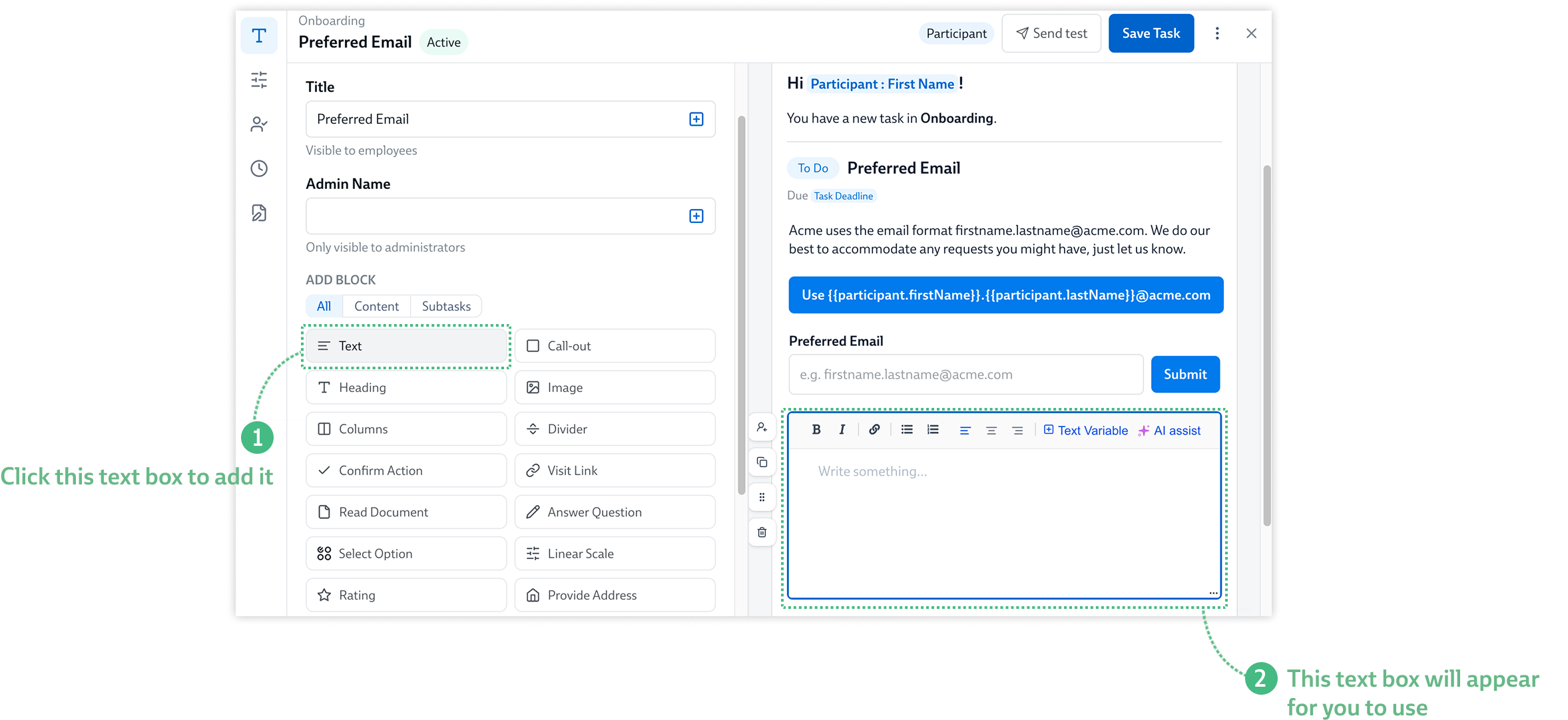
To add a new content or subtask block to your Task or Message, start by opening the Message or Task you’d like to change, in edit mode.
Then open the Content tab in the left sidebar and find the Add block section. Use the All, Content and Subtasks tabs to filter the blocks, then drag the block you want over to where you’d like it in the preview. (Messages only show content blocks.)
Once you’ve positioned the block, its settings open in the left sidebar.
Changing the options in a Select Option subtask
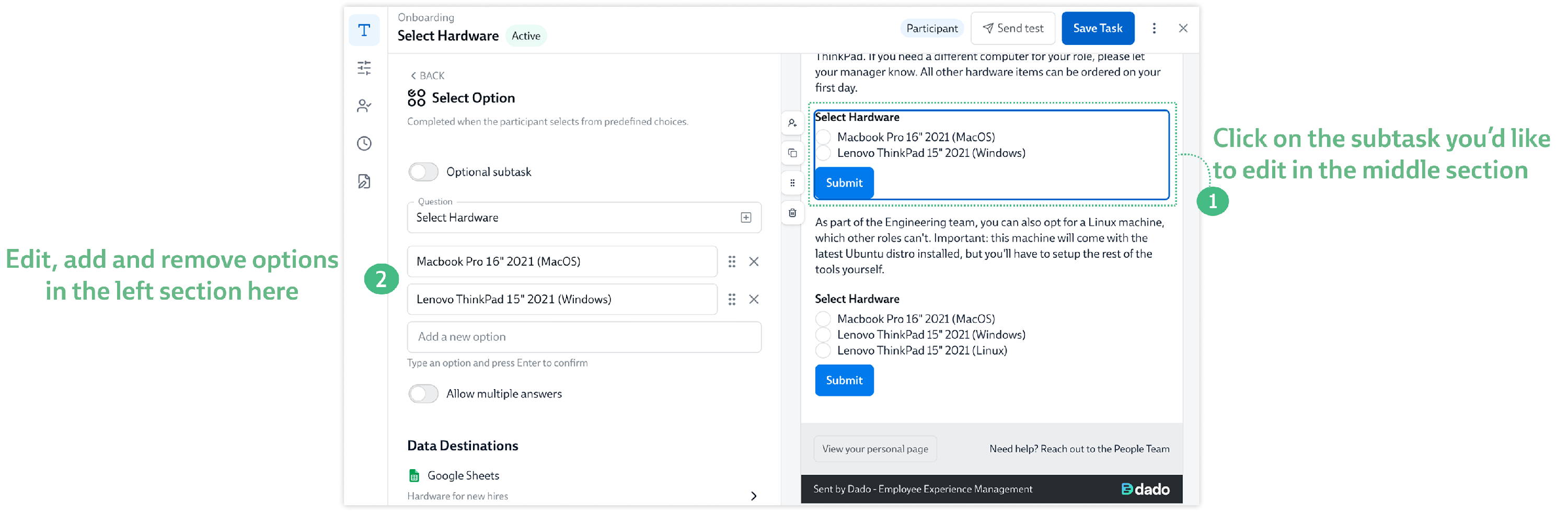
Open the Task you’d like to change, in edit mode. Click the subtask you’d like to edit in the preview. Its subtask settings open in the left sidebar.
Here you can change the text of existing options, delete options or add new options. Please note: when you add a new option, you’ll need to press Enter to confirm the addition.
You can also switch between the subtask being a single-select, or a multi-select, using the Allow multiple answers toggle.
Don’t forget to save when you’ve made your changes!
Options in this kind of subtask are often used for segments (also known as Target Audiences) later in the Experience. Please check with your Customer Success Manager when you make changes here, so they can update any segments as necessary.
Changing links, in Visit Link subtasks and in text blocks
There are two ways links can be used in a Dado Experience:
- A normal link that appears in text. This kind of link is not tracked, so you won’t be able to see any reporting on whether people have clicked it
- A Visit Link subtask. Like every other subtask in Dado, this is tracked. You will be able to see when it has been clicked and (unless this subtask is marked as optional), assignees will receive reminders until they have clicked the link.
Changing links in text blocks
In Text blocks, Dado uses the common formatting tool called "Markdown". This is how links appear in Markdown:

To add a new link
- click the text block in the preview, so it becomes editable
- click the link icon in the toolbar above the text
- this will insert the brackets needed to make a link
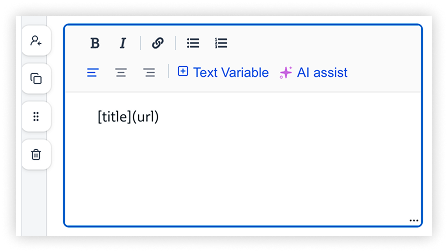
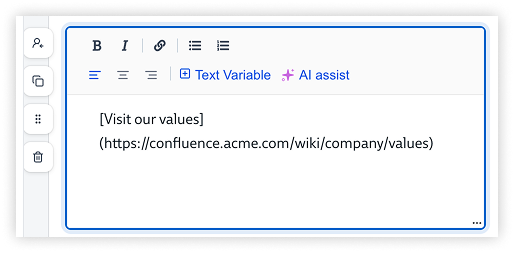
- add the URL inside the round brackets ( )
- add the anchor text you’d like inside the square brackets [ ]
- make sure there are no spaces between the square and round brackets
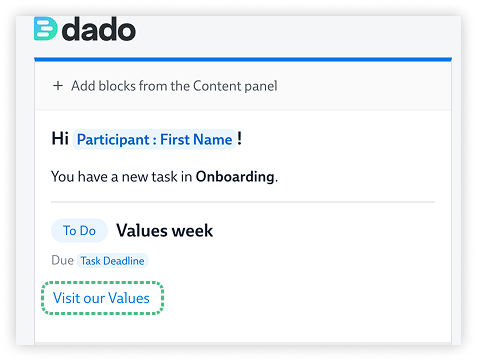
- check the preview to be sure that the link appears as you wish
How to change an existing link
- click the relevant text block in the preview, so it becomes editable
- find the link you want to change. You’ll recognize it by the square [ ] and round brackets ( )
- to change the visible anchor text, change the text inside the square brackets [ ]
- to change the URL, change the text inside the round brackets ( )
- check the preview to be sure that the link appears as you wish
Changing links in Visit Link Subtasks
- click the relevant Visit Link Subtask in the preview
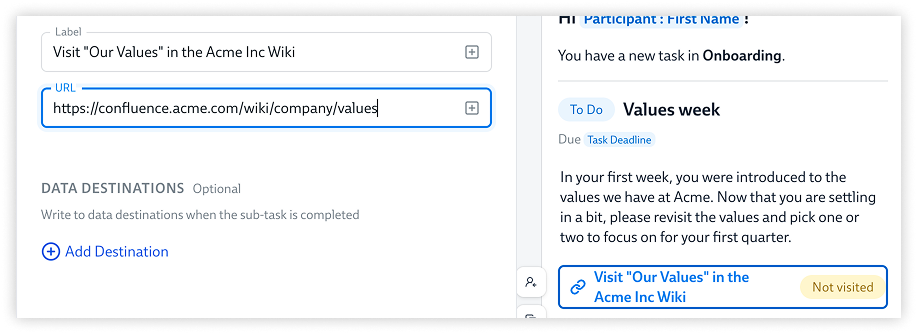
- this will open the Subtask settings in the left sidebar. Change the Label to edit the visible link text, and the URL to change where the link goes.
Changing the notification channels for a Task or Message
Open the Message or Task you’d like to change, in edit mode.
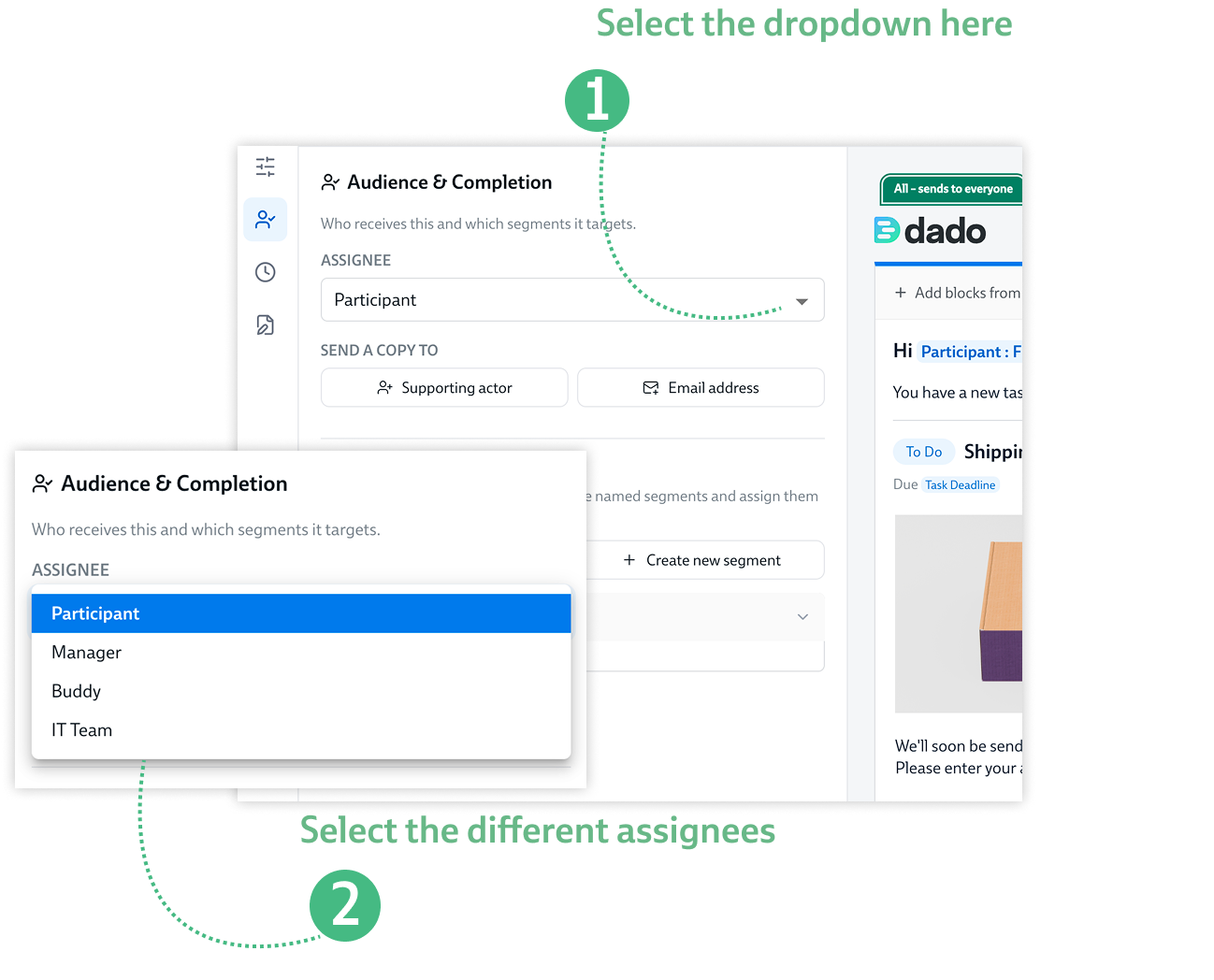
To change who receives it, open the Audience & completion tab in the left sidebar and choose a different Assignee from the dropdown. You can also use Send a copy to to copy in a Supporting Actor or an email address.
Changing the reminder settings for a Task
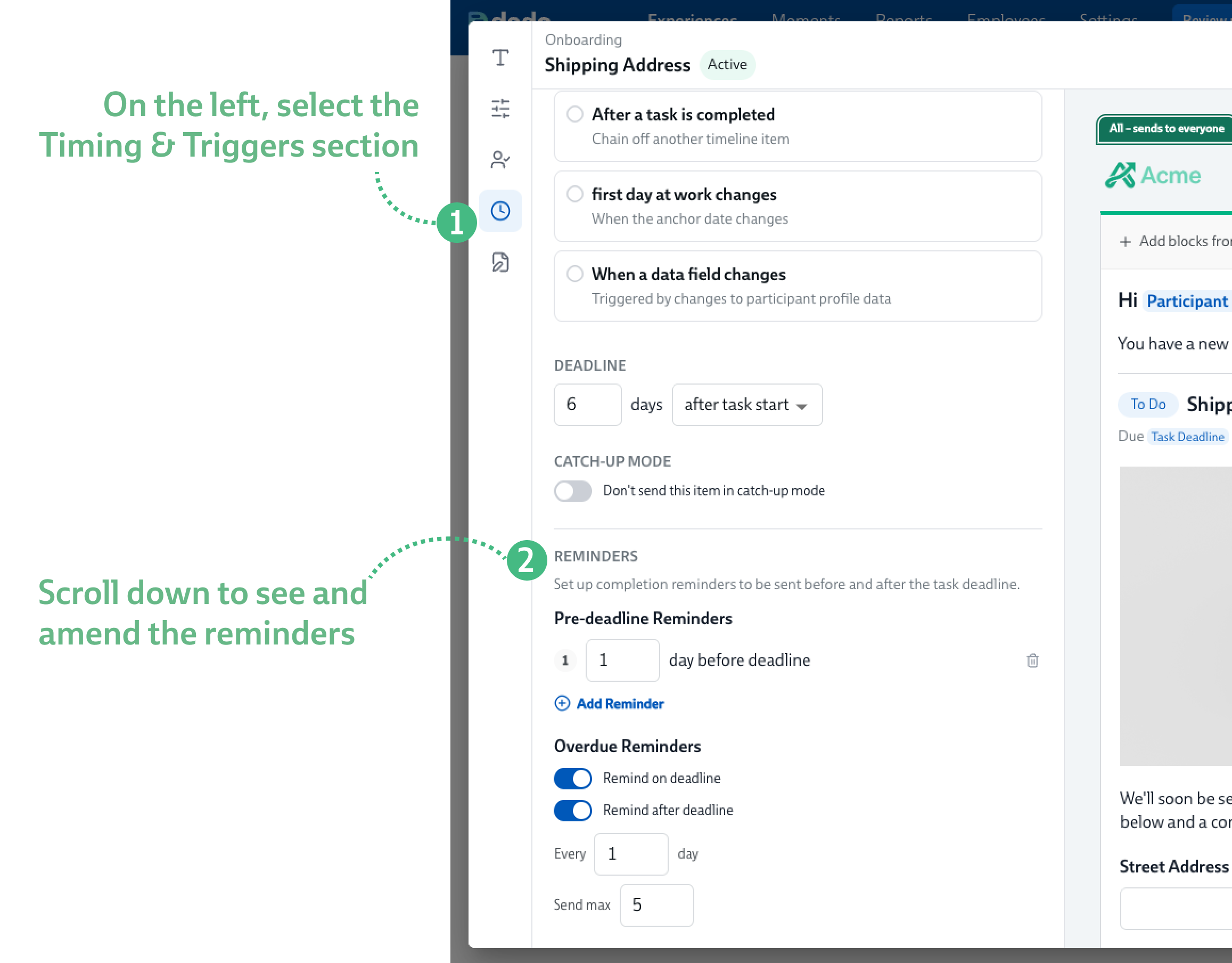
Open the Task you’d like to change, in edit mode. In the left sidebar, open the Timing & triggers tab and scroll to Reminders.
Under Pre-deadline Reminders, set how many days before the deadline a reminder is sent, and use Add Reminder to add more. Under Overdue Reminders, switch on Remind on deadline and/or Remind after deadline. For post-deadline reminders, you can customize:
- how often the reminders are sent, e.g. once every 3 days, or every day (Every)
- how many reminders will be sent in total, e.g. 5 (Send max)
Don’t forget to save when you’ve made your changes!
If you have set anyone to receive a copy of the task, they will not receive any reminders – just the original task start notification.
Changing the deadline for a Task
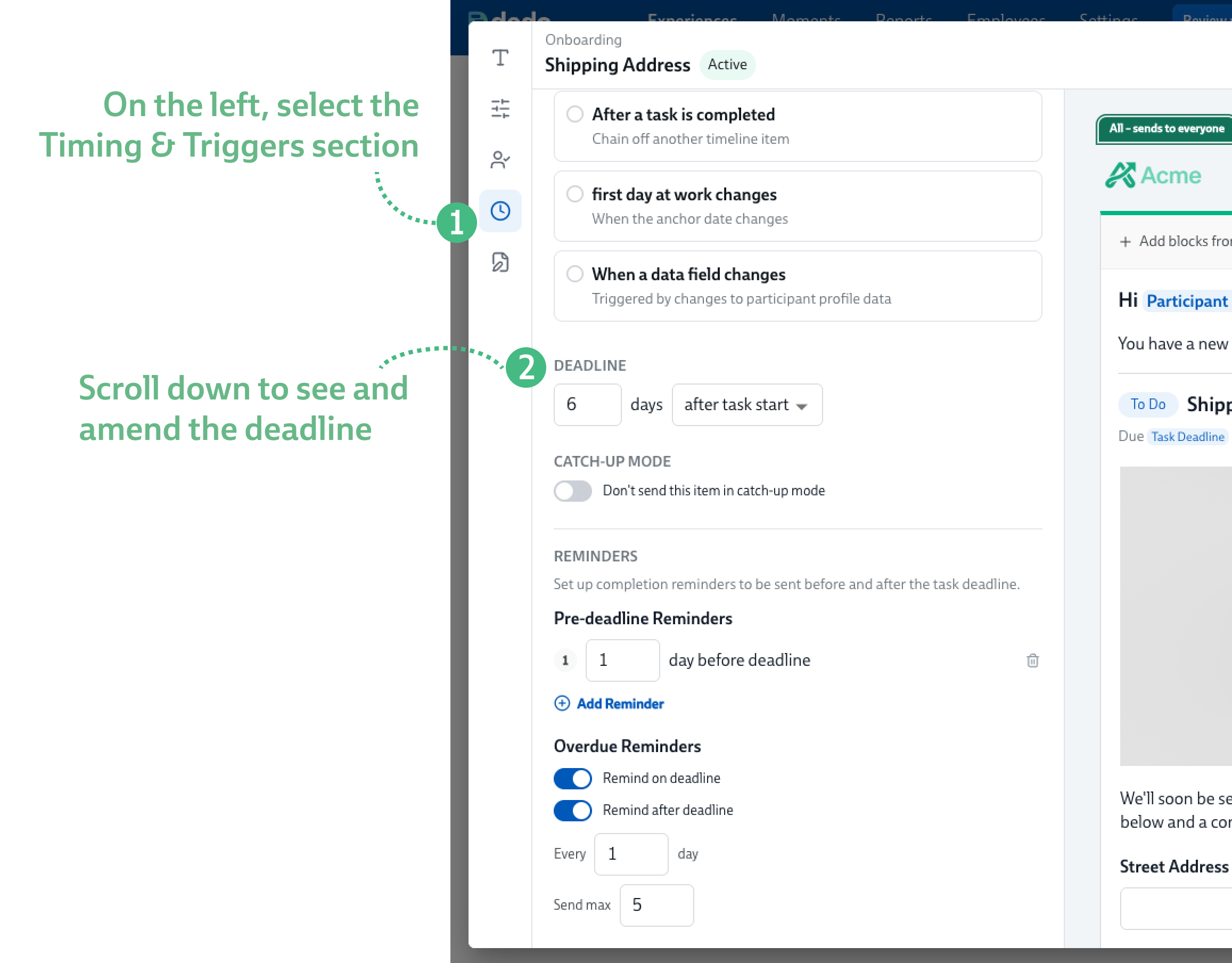
Open the Task you’d like to change, in edit mode. In the left sidebar, open the Timing & triggers tab. Under Deadline, set how long after the Task starts it is due.
Don’t forget to save when you’ve made your change
Changing the start/send date for a Task or Message
The start/send of Tasks and Messages can be set on a specific relative date on the Timeline, e.g. 5 days after the Experience starts, or triggered by something else, such as the completion of a preceding Task.
When a Task or Message has a specific start date, you can drag the Task/Message on the Timeline to set a different start date.
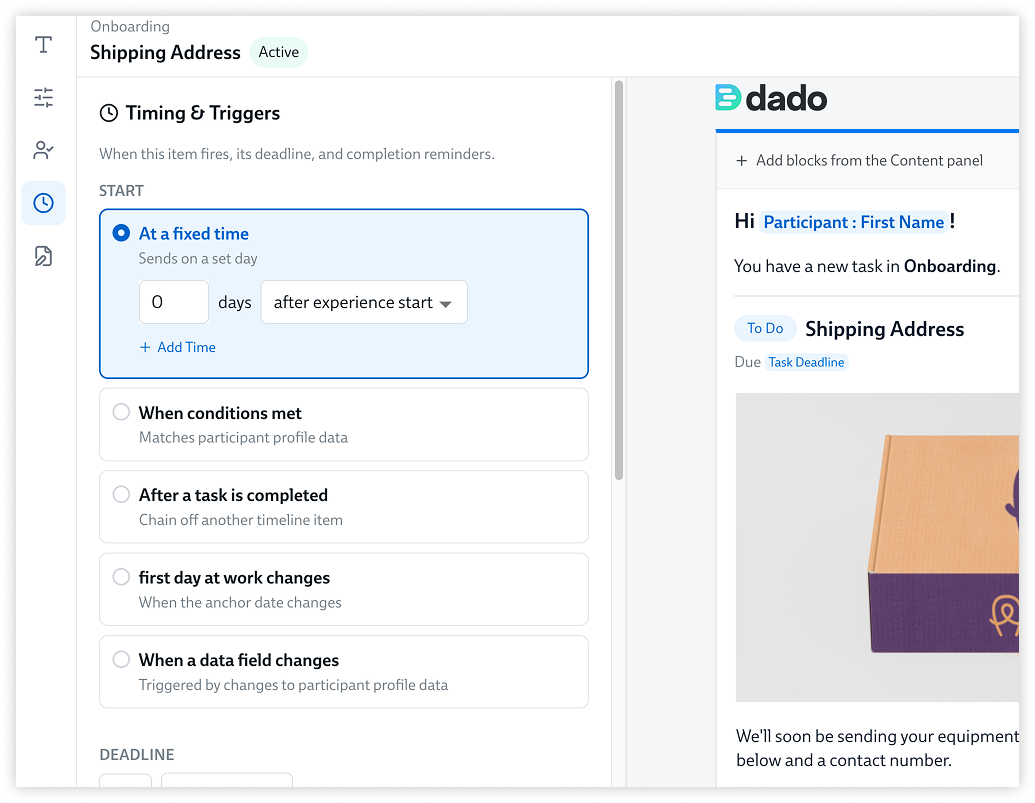
You can also open the Task or Message in edit mode and use the Timing & triggers tab. Under Start, choose how it should start:
- At a fixed time: sends on a set day
- When conditions met: matches participant profile data
- After a task is completed: chain off another Timeline item
- When the anchor changes: for instance, for an onboarding, when the first day at work changes
- When a data field changes: triggered by changes to participant profile data
For more on these options, see Understanding the different ways to trigger a Task/Message/Automation.
Don’t forget to save when you’ve made your changes!
Changing which parts of a Task or Message are assigned to a Target Audience
To change the content assigned to a segment (also known as a Target Audience), start by opening the Task or Message you’d like to change, in edit mode. You can then specify which blocks are shown to that segment. A block can be a subtask, a text block, a heading, a callout or an image.
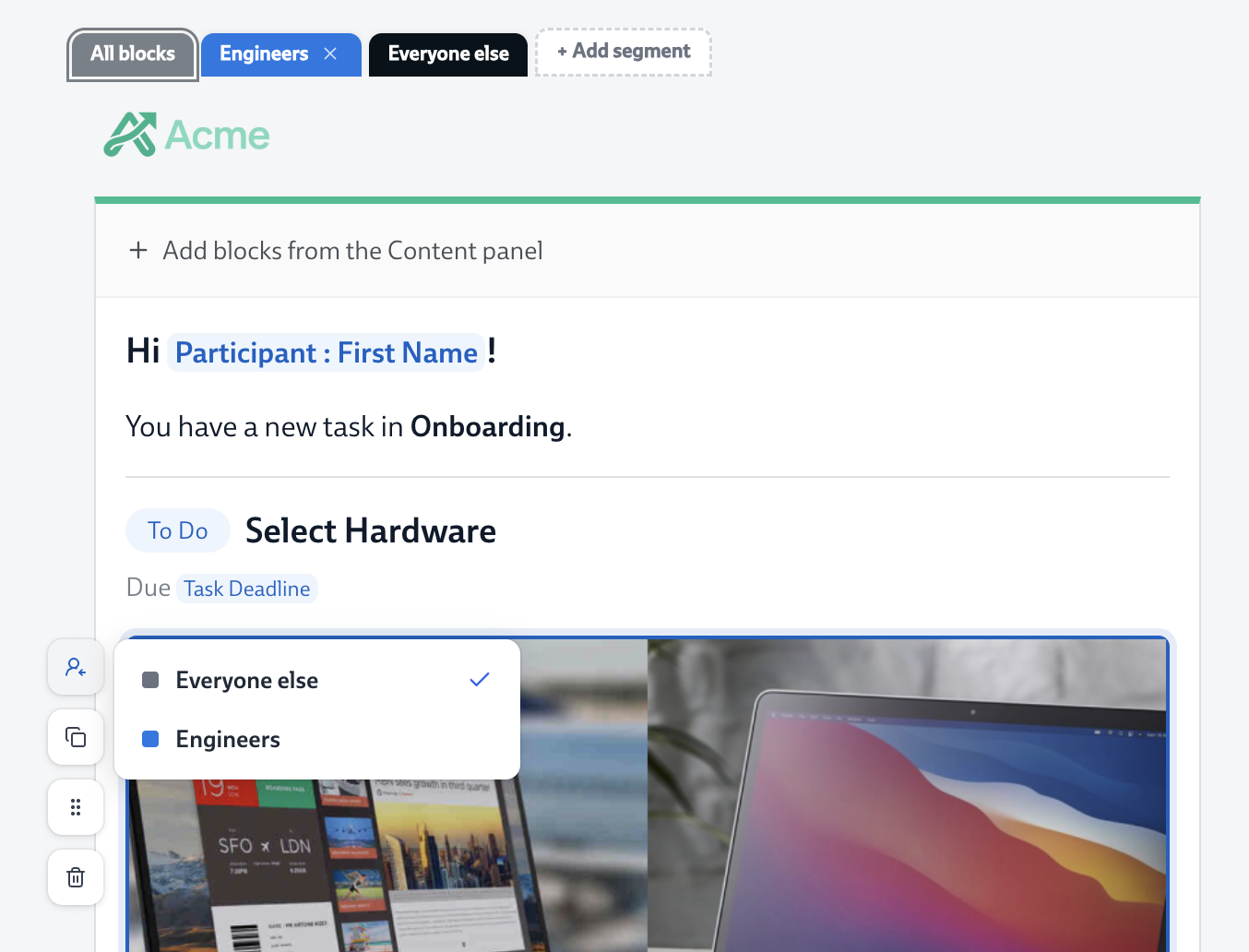
- In the middle section, click on the segment tab to see what content is currently assigned to that segment.
-
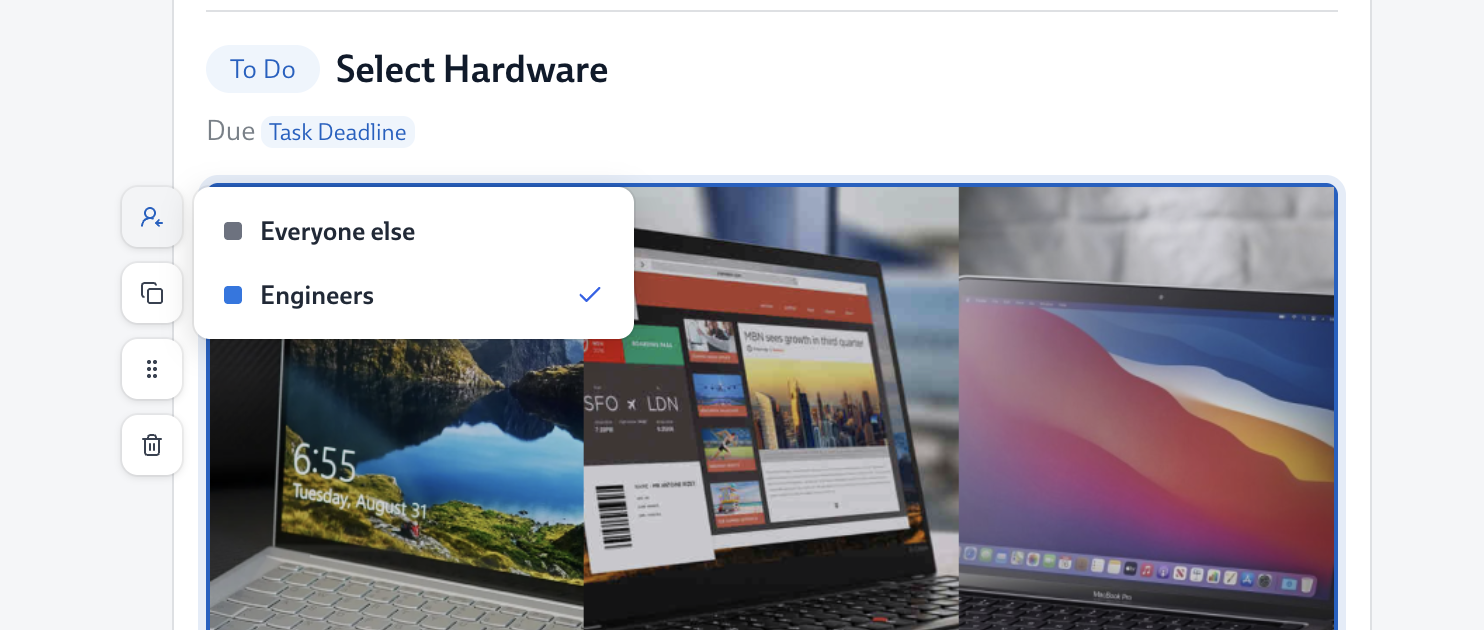
To hide a block currently assigned to that segment, hover over that block and click on the segment settings icon. Deselect the segment and the block will be unassigned from that segment.
-
To assign a block to that segment that's not currently assigned, click on the All Blocks tab, and then find the block you wish to assign. Hover over that block and click on the segment settings icon, then select the segment. The block is now assigned to that segment.
- Save the Task or Message, and the Experience as usual.
